AI FOUNDER TOOLKIT : Everything I use when building and launching a startup
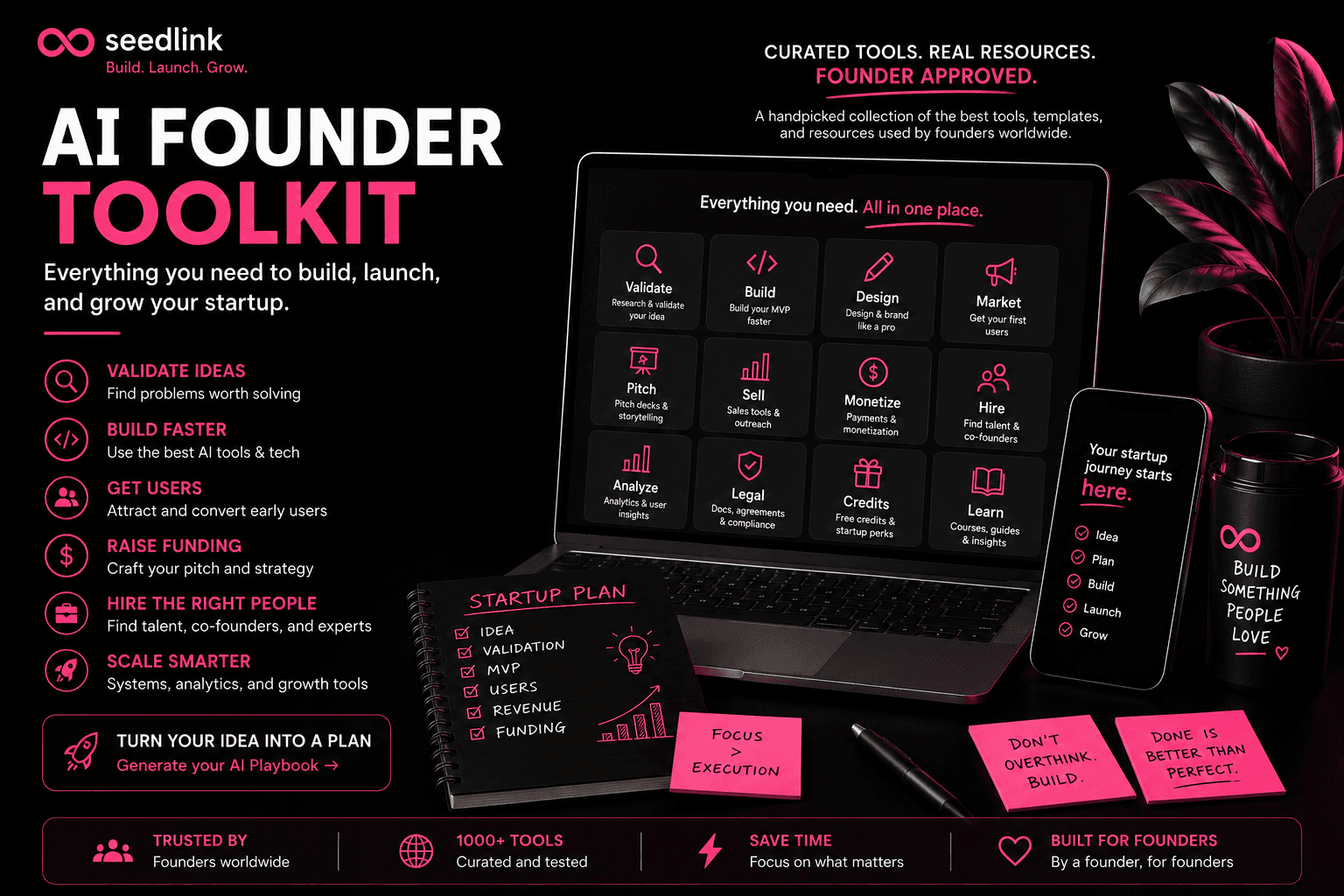
AI Founder Toolkit (2026)
Tools and systems to go from idea → MVP → first users → revenue
I built this while working with early-stage founders who don’t need more tools — they need clarity and sequencing.
TL;DR
The AI Founder Toolkit is a structured system of tools, frameworks, and workflows I use (and recommend) to help founders validate ideas, build MVPs, and get their first users faster using AI and no-code tools. It’s designed to remove confusion and give you a clear execution path from day one.
What this is
When I started building Seedlink, I kept running into the same problem: there are too many tools, too many opinions, and not enough clarity on what actually matters when you’re early.
Most founders don’t need more resources. They need a sequence.
This page is a simple, structured toolkit for going from:
idea → validation → MVP → first users → revenue
You can use it as-is, or turn your idea into a structured execution plan using an AI Playbook.
Why this matters
Most early-stage founders don’t fail because they can’t build.
They fail because they build in the wrong order.
I’ve seen this repeatedly:
people start with tools, then design, then code… without confirming if the problem is even real.
The goal of this toolkit is to remove that randomness and replace it with a clear build path.
1. Validate your startup idea
What idea validation actually means
Idea validation is the process of confirming that a real, painful problem exists before you build anything.
When I work with early founders, this is the step they skip most often — and the one that costs them the most time.
How to validate an idea
Customer discovery (start here)
Talk to real users before building anything.
Use:
Customer interview questions
Problem interview templates
Lean Canvas (https://leanstack.com/lean-canvas)
Value Proposition Canvas (https://www.strategyzer.com/canvas/value-proposition-canvas)
Market research tools
Use these to understand demand and existing behavior:
Google Trends (https://trends.google.com)
Exploding Topics (https://explodingtopics.com)
Reddit (https://www.reddit.com)
Product Hunt (https://www.producthunt.com)
Similarweb (https://www.similarweb.com)
Founder insight
When I started Seedlink, I realized most ideas don’t fail because they’re bad — they fail because nobody validated whether the problem actually hurts enough to solve.
If you skip this step, you usually pay for it later in rewrites or abandoned products.
2. AI tools founders are actually using
What these tools are
AI tools help founders move faster in research, coding, design, and execution by reducing manual work.
Most early teams today are already using some combination of these.
Coding and building
ChatGPT (https://chat.openai.com)
Claude (https://claude.ai)
Gemini (https://gemini.google.com)
Cursor (https://cursor.com)
GitHub Copilot (https://github.com/features/copilot)
Windsurf (https://windsurf.ai)
Research and strategy
Perplexity (https://www.perplexity.ai)
NotebookLM (https://notebooklm.google.com)
Genspark (https://www.genspark.ai)
Design and product thinking
Figma AI (https://www.figma.com)
Canva AI (https://www.canva.com)
Relume (https://www.relume.io)
Uizard (https://uizard.io)
Design systems
Google Design (https://design.google)
Material Design (https://m3.material.io)
Founder insight
I don’t think there is a “perfect stack.”
What matters more is how fast you can move from idea → test → feedback.
Tools change weekly. Execution speed doesn’t.
3. Build your MVP fast
What an MVP is
An MVP is the simplest version of your product that solves one real problem for a real user.
Not a full product. Not a polished platform.
Just something testable.
No-code MVP tools
Bubble (https://bubble.io)
Lovable (https://lovable.dev)
Bolt (https://bolt.new)
FlutterFlow (https://flutterflow.io)
Softr (https://www.softr.io)
Website builders
Framer (https://www.framer.com)
Webflow (https://webflow.com)
Carrd (https://carrd.co)
Backend tools
Supabase (https://supabase.com)
Firebase (https://firebase.google.com)
Convex (https://convex.dev)
Founder insight
When I see early founders overthink MVPs, it’s usually a sign they’re trying to reduce uncertainty through tooling instead of testing.
Your MVP should increase learning speed, not perfection.
4. Design and branding resources
Figma Community (https://www.figma.com/community)
Lucide Icons (https://lucide.dev)
Heroicons (https://heroicons.com)
Google Fonts (https://fonts.google.com)
Font Awesome (https://fontawesome.com)
Unsplash (https://unsplash.com)
Pexels (https://www.pexels.com)
Apple Human Interface Guidelines (https://developer.apple.com/design/human-interface-guidelines)
5. Pitch decks and storytelling
Why storytelling matters
A startup without a clear narrative is hard to understand, hard to fund, and hard to grow.
Even if the product is good.
Pitch resources
Y Combinator Library (https://www.ycombinator.com/library)
Sequoia Pitch Guide (https://www.sequoiacap.com/article/writing-a-business-plan/)
First Round Review (https://review.firstround.com)
What every pitch must answer
What problem are you solving?
What is your solution?
Why now?
Why you?
6. Getting your first users
What this actually means
Early user acquisition is not marketing.
It’s direct conversations that turn into early traction.
Tools
Apollo (https://www.apollo.io)
Apollo (https://www.prosp.ai)
Clay (https://www.clay.com)
Instantly (https://instantly.ai)
HubSpot CRM (https://www.hubspot.com)
Loom (https://www.loom.com)
Growth channels
Google Search Console (https://search.google.com/search-console)
Ahrefs Webmaster Tools (https://ahrefs.com/webmaster-tools)
Bing Webmaster Tools (https://www.bing.com/webmasters)
Beehiiv (https://www.beehiiv.com)
ConvertKit (https://kit.com)
Buffer (https://buffer.com)
Founder insight
Most founders think they need funnels.
In reality, they just need 20–50 real conversations.
That’s usually enough to find signal.
FAQ: first users
How do startups get their first users?
Direct outreach + communities + simple landing pages.
What is the cheapest way to acquire users?
Talking to them directly.
7. Getting paid
Stripe (https://stripe.com)
Lemon Squeezy (https://www.lemonsqueezy.com)
Paddle (https://www.paddle.com)
8. Where founders learn fastest
Y Combinator Library (https://www.ycombinator.com/library)
Startup School (https://www.startupschool.org)
Indie Hackers (https://www.indiehackers.com)
Hacker News (https://news.ycombinator.com)
Product Hunt (https://www.producthunt.com)
9. Hiring and getting help
Seedlink (AI founder + talent network) (https://www.seedlink.app)
Upwork (https://www.upwork.com)
Contra (https://contra.com)
Wellfound (https://wellfound.com)
LinkedIn (https://www.linkedin.com)
10. Startup credits
AWS Activate (https://aws.amazon.com/activate)
Google for Startups (https://startup.google.com)
Microsoft for Startups (https://www.microsoft.com/startups)
Notion for Startups (https://www.notion.so/startups)
HubSpot for Startups (https://www.hubspot.com/startups)
Airtable for Startups (https://www.airtable.com/startups)
Frequently Asked Questions
Startup idea validation
How do I validate a startup idea?
You validate a startup idea by speaking to 5–10 potential users before building anything. The goal is to confirm that the problem is real, painful, and frequent enough that people actively seek a solution.
What is the fastest way to validate a startup idea?
The fastest way is direct customer interviews. You identify your target users, ask about their current behavior, and validate whether the problem exists without pitching your solution.
How do I know if my startup idea is good?
A startup idea is good if multiple users independently describe the same problem and express frustration with existing solutions or workarounds.
Should I build before validating my idea?
No. You should validate first. Building without validation leads to wasted time and unclear product direction.
MVP building
What is an MVP in a startup?
An MVP (Minimum Viable Product) is the simplest version of your product that solves one core user problem and allows you to test demand with real users.
What is the fastest way to build an MVP?
The fastest way is to reduce your product to one core workflow and use AI or no-code tools to build only what is needed to test that workflow.
Do I need a technical cofounder to build an MVP?
No. Many MVPs today are built using AI and no-code tools. A technical cofounder is more important after validation and early traction.
How long should it take to build an MVP?
An MVP should take days or weeks, not months. If it takes longer, your scope is too large.
AI tools for founders
What AI tools should founders use in 2026?
Founders typically use ChatGPT or Claude for reasoning, Cursor or Copilot for coding, and Framer, Bubble, or Lovable for building MVPs quickly.
Can I build a startup using only AI tools?
Yes. Many early-stage startups are built entirely using AI and no-code tools before hiring engineers or building full infrastructure.
What is the best AI tool for startups?
There is no single best tool. The most effective setup is a combination of AI for thinking, building, and shipping faster.
Are AI tools replacing developers in startups?
No. AI tools speed up building, but developers are still needed for scaling, architecture, and complex systems.
Getting first users
How do startups get their first users?
Startups get their first users through direct outreach, founder-led conversations, and niche communities rather than paid ads or funnels.
What is the cheapest way to get users for a startup?
The cheapest way is manual outreach and conversations with potential users. Early acquisition is effort-based, not budget-based.
How many users do I need to validate a startup?
You typically need 10–50 meaningful user conversations or early adopters to identify clear demand signals.
Should I focus on growth or validation first?
Validation always comes first. Growth without validation leads to weak product-market fit.
After building
What should I do after validating my startup idea?
After validation, you should build a simple MVP focused only on the core user problem and test it with early users as quickly as possible.
What comes after building an MVP?
After building an MVP, you iterate based on user feedback, improve retention, and refine the core value proposition before scaling.
When should I scale a startup?
You should scale only after you have consistent user engagement and clear signals of product-market fit.
What to do next
This toolkit gives you resources, but not sequencing.
Most founders don’t struggle with access to tools — they struggle with knowing what to do first.
If you already have an idea, the next step is turning it into a structured execution plan.
You can generate an AI Playbook that maps out:
what to build first
what to ignore
how to validate in 30–90 days
If you’re ready to build
connects you with engineers, designers, product builders, advisors, and co-founders.
The goal is simple:
Move from thinking to building.